Tuesday, March 20, 2018

ReFoReMo Day 14 Book Reviews


BEAR HAS A STORY TO TELL by Philip Stead

Bear is sleepy, but before settling down for his long winter's nap he has a story he wants to tell. He finds Mouse and asks him if he would like to listen to a story. But, Mouse is too busy gathering seeds for the upcoming winter. Mouse says he will listen to the story in the spring. Then Bear asks Duck and Frog, but each of them are preparing for the long winter ahead. Unable to find a listener, and unable to stay awake any longer, Bear falls asleep. What will happen when he awakes in the spring?

BEFORE MORNING by Joyce Sidman

Before going to bed, a young boy prays for snow. When he wakes up, his prayer has been granted, and his harsh world has been transformed by a soft blanket of snow.

This isn't your typical story about a boy making a wish or saying a prayer. Rather is it more of a visual telling of the transformation from a cold, hard world to a cold but soft one. I counted just 66 words in all. The book begins with four pages with not text at all and ends with two pages of no text. The writing is poetic and the illustrations are magical.

FLASHLIGHT NIGHT by Matt Forrest Esenwine 


A short rhyming text by Mat Forrest Esenwine and delightfully spooky illustrations by Fred Koehler combine for a look at how much of an adventure it can be to read an adventurous tale by the light of a flashlight.

THIS HOUSE, ONCE by Deborah Freedman

With just over 100 words, beautifully expressive illustrations, author/illustrator Deborah Freedman tells readers how things that were once other things, or that were once in other places, have been changed and moved to build that house. For instance, the door for the house was once a mighty oak, and the stones foundation around the house were buried under the ground. She goes on to describe the brick walls, the windows and the roof. Kids will learn a bit about home construction that they probably never knew.

At the end of the book, Freedman tells her readers that her house  in New England is similar to the one described in the book. Then she asks: "Where do you live? What was your home, once?" This provides a great springboard for discussion about where people live, what type of house they live in, and what their house is made of.

THE UNCORKER OF OCEAN BOTTLES by Michelle Cuevas 

The Uncorker of Ocean Bottles lives alone at the top of a hill. He has a very important job, that of opening bottles that have been dropped into the sea and delivering the messages found in those bottles. His job is very rewarding, as he loves delivering otherwise lost messages to their recipients, and he travels far and wide making sure all the messages are delivered.

But, one day, he finds a message that isn't addressed to anyone. It is simply a party invitation. It says: "I'm not sure you'll get this in time, but I am having a party. Tomorrow, evening tide, at the seashore. Will you please come?"

Not sure what to do, he travels through the village where he lives and asks each person if they had put the invitation in the bottle of if they might know anything about it. No one knows what it's about. The Uncorker of Ocean Bottles decides to go to the seashore the next evening, just to see what happens. The ending is very sweet and satisfying.


Monday, March 19, 2018

ReFoReMo Day 13 Book Reviews


BE A KING By Carole Boston Weatherford

Author Carole Boston Weatherford encourages readers to "be a king." One way, she says is to, "stamp out hatred. Put your foot down and walk tall." The author uses words and phrases from King's life and shows young readers how they can be like King, they can "Be a King" by doing the things that Martin Luther King did.


BRAVE  by Stacy McAnulty

You don't have to have superpowers to be a hero. You can "save the world, just by being brave." Author Stacy McAnulty shows readers how they can change their worlds by being brave in the face of adversity. They can try new things, confront bullies and stand up for what they think is right.

DEAR GIRL by Amy Krouse Rosenthal and Paris Rosenthal

Written like short letters to a girl, each two-page spread begins, "Dear Girl." The letters are encouraging notes to a girl to help her in her everyday activities. For instance, one letter reads: "Dear Girl, Make your room awesome. Make your room you. And while you're at it, make your bed!" This is the kind of book that any young girl could relate to and it is the perfect gift, for any occasion, for mothers, big sisters and others to give to their "dear" girls.


LIFE by Cynthia Rylant 


For all of us, no matter how big we end up, we all start the same way: "Life begins small, then grows..." This is a touching book about life, the good things and the bad things. Author Cynthia Rylant uses thought-provoking sentences to make the reader think about their life: "Life is not always easy." And, "there is always a new road to take." Brendan Wenzel illustrates the book beautifully with nature scenes that greatly enhance the text.

LOVE IS by Diane Adams

A young girl gets a baby duck for a pet, and as the baby duck grows up, the young girl learns what love really is. The book starts out with this line, "Love is holding something fragile, tiny wings and downy head." The story progresses as the baby duck grows up and "leaves the nest." The young girl goes through all the stages of love with her baby duck that parents do with their human babies.


LOVELY by Jess Hong 

No matter what we look like, whether we are big or tall, we have curly or straight hair, we are young or old, we are ALL lovely in our own way.

MOST PEOPLE by Michael Leannah

This book celebrates the idea that "most people" are good people, that they want to be kind and helpful. Yes, there are some bad people in the world, but if "you line up all the people who want to be good and all the people who want to be bad, the good line would stretch from here to the tallest mountain. All the people in the bad line could crowd together in a dark and gloomy room."


PEACE IS AN OFFERING by Annette LeBox
 
"Peace is an offering.
A muffin or a peach.
A birthday invitation.
A trip to the beach."

So begins this lovely book about being a community and being good neighbors and finding love - and peace - in the everyday things around you. The lyrical verse and softly shaded illustrations combine to make a beautiful book for all to enjoy.


WHY AM I ME? by Paige Britt

Two characters ask the same question: "Why am I me?" Then they explore the answers separately until they come together in the end. The idea is that there is no you or me, just an us and we, that we are all human and we need to show compassion and love for each other.


YOU HOLD ME UP by Monique Gray Smith 


"You hold me up when you are kind to me, when you share with me, when you learn with me." So begins this touching book giving children examples of simple ways to show their love and support for each other. Just six sentences and 68 words, paired with colorful, expressive text, create a picture book that is worth sharing. 


Friday, March 16, 2018

ReFoReMo Day 12 Book Reviews


BEAUTIFUL by Stacy McAnulty 


With just 71 words and an abundance of wonderful illustrations, this book celebrates girls and what makes them beautiful. It's not how they look; it's about how they act and how they accept challenges. The illustrations show that it's okay for girls to be messy, to enjoy science and to just be themselves.

DOUBLE TAKE: A New Look at Opposites by Susan Hood

So, you think you know all about opposites, right? Like the opposite of yes is no and the opposite of asleep is awake. But, this book takes the subject of opposites to a whole new level. It discusses (and shows in the illustrations) concepts like point of view and perspective. Its rhyming text and lively illustrations ensure that kids will enjoy learning more about opposites than they had probably ever considered.

SMALL by Gina Perry 

The girl in this book is small. She rates her size in accordance to the world around her. The first sentence of the book is "The city is big and I am small." She points out ways that show that she is small in relation to the world around her. But, then she discovers ways to feel big - by flying through the air on a swing and making big chalk drawings on the sidewalk and seeing the world from the top of a ferris wheel. She might be little in stature but she is also big and strong in other ways.

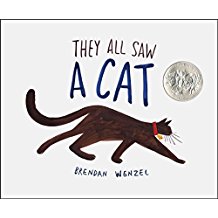
THEY ALL SAW A CAT by Brendan Wenzel

They ALL saw a cat: a child, a dog, a fox, a fish, a mouse, a bee, a bird, a flea, a snake, a skunk, a worm, and a bat. But, each one saw the cat a bit differently.


This is a great book about perception and imagination. We can each see the same thing, but we probably won't see it the same way.

WINDOWS by Julia Denos

Before going to bed, a young boy heads out for a walk around is neighborhood. He sees the windows in the houses and other buildings in his neighborhood, catching glimpses of their nightly routines - brushing their teeth, fixing dinner, watching television, etc. When the young boy returns home from his walk, he sees his mother waving to him through the window in his house. Author Julio Denos and illustrator E.B. Goodale have put together a book that offers an unique glimpse into the windows of people's lives.


Thursday, March 15, 2018

ReFoReMo Day 11 Book Reviews


BIRD, BALLOON, BEAR by Il Sung Na

It's Bird's first day in the forest. She is looking for a friend. She sees Bear. Bird wants to introduce herself but she's too shy. Before she can work up the nerve to say, "Hello," Bear has already found a
friend. A big, red Balloon floats by Bear and he starts playing with it. Bear and Balloon play all day long. Poor Bird can only sit and watch. Will she ever get a chance to be friends with Bear?

EVERY DAY BIRDS by Amy Ludwig

"Every day we watch for birds weaving through the sky.
We listen to their calls and songs.
We like to see them fly."

So begins this poem that has been transformed into a picture book. From there we learn a bit about the chickadee, the jay, the nuthatch and the finch, as well as 16 other types of birds. Several pages at the end of the book contain additional information about each type of bird mentioned in the book.

This is a great way to introduce young readers to the subject of birds. Not only are the illustrations colorful and expressive, and the text not only rhymes, the sentences are very short.

LOVE, MAMA by Jeanette Bradley 

When Kipling's mama goes on a long trip and leaves him behind, she says she'll be home soon. But, she doesn't come back by dinnertime or by bedtime or even the next day. Or the next... Kipling misses her very much and searches for ways to comfort himself, but nothing takes the place of Mama's love.

Then, a package from Mama arrives in the mail with some of this favorite things in it and a letter from Mama. She assures Kipling that her love can reach him wherever he is. She signs the card Love, Mama. Kipling realizes he has her love even if she isn't right there with him.

MY BEAUTIFUL BIRDS by Suzanne Del Rizzo

When Sami is forced to flee his home because it has been blown apart (along with those of his neighbors), he is forced to leave his pigeons behind. Even though Sami and his family eventually make it safely to a refugee camp, Sami wonders about his birds and hopes that they are okay. He is so concerned about the birds that he finds it difficult to concentrate on anything else.

Then one day he begins to notice there are birds around the camp. He then makes it his job to take care of those birds.

Author Suzanne Del Rizzo is also the illustrator. The story is a moving one, to be sure. But her illustrations are just amazing. She used Plasticine and polymer clay and other things to create 3D images for the illustrations. They are very detailed and life-like and provide an added dimension (pardon the pun) to the book.
 
THE DAY I BECAME A BIRD by Ingrid Chabbert Guridi

I haven't read this book yet. I will add my review after I have had a chance to read the book.


Wednesday, March 14, 2018

ReFoReMo Day 10 Book Reviews


BLOCKHEAD: The Life of Fibonacci by Joseph D'Agnese

Leonardo Fibonacci was a mathematician who lived in the middle ages. He had a penchant for numbers and all things mathematical. His nickname was Bigollo, which is loosely translated to mean, Blockhead. Fibonacci is best known for what is called the Fibonacci Sequence, a sequence of numbers that describes how things like flowers grow in an orderly fashion. It is also prevalent in architecture, music, poetry and art.

A page at the back of the book provides some additional biographical information about Fibonacci. The last page of the book makes this an interactive picture book. First, it challenges the reader to go back through the book and find a flower with eight petals, a lemon with eight sections, and a clover with three leaves. Then, the reader is instructed to continue looking through the book to see if they can find any additional items that have Fibonacci numbers in them. There are also several other math and number related activities listed on the last page.

FINDING WINNIE: The True Story of the World's Most Famous Bear by Lindsay Mattick 


This wonderful book was written by Lindsay Mattick, the great-granddaughter of Captain Harry Colebourn. Captain Colebourn, a vet, was on his way to tend to the soldier's horses during the war, when he came upon a man with a bear cub. The captain bought the cub and named her Winnipeg, calling her Winnie, for short. He trained her and she became the mascot for the Second Canadian Infantry Brigade. When the troops were sent out to fight, Capt. Colebourn had to leave Winnie behind. He was in  England at the time, and he drove Winnie to the London Zoo, where she lived out the rest of her days.

She became a favorite attraction at the zoo. One day, little Christopher Robin Milne went to the zoo with his father. Christopher Robin fell in love with Winnie. He and the bear became great friends. Christopher Robin had a stuffed bear at home that he named Winnie-the-Pooh. His father, A.A. Milne, wrote great stories about the adventures of Christopher Robin, Winnie-the-Pooh and their friends in the Hundred Acre Woods.

Mattick writes the story in a refreshingly creative way. She begins by having a young boy curling up with mom while mom reads the story. The little boy keeps interrupting the mother as she reads, as children often do. In this manner, Mattick tells the story of how Winnie-the-Pooh became famous.

IRA'S SHAKESPEARE DREAM by Glenda Armand

Ira Aldridge wanted to be an actor, and not just any actor. He wanted to act in Shakespeare plays. There were problems with this: (1) He was black. (2) He lived in the United States during a time when slavery was still legal. Even so, he pursued his dream at an all-black theater located in New York City. He eventually left the United States and went to England, where he became the first black man to play the part of Othello on a stage there. He is also the only black man to have his name inscribed on a plaque at the Shakespeare Memorial Theatre in England.


LOST AND FOUND CAT: The True Story of Kunkush's Incredible Journey by Doug Kuntz and
Amy Shrodes

When an Iraqi family leaves their home to flee for safety, they want to take their cat, Kunkush, with them. They are being smuggled out of the country by various people, any of whom would either not permit them to take their cat, or who would charge them a lot of extra money to do so. Because they can't afford to pay more, and because they can't bear to leave Kunkush with them, the family manages to hide the cat in a basket where no one would see or hear him.

This arrangement works well for much of the journey. But, after a perilous voyage across the waters to Greece, the latch on the cat's basket becomes undone. The cat is frightened when they finally reach land and he sneaks out of the basket when no one is looking. Although they search and search, the can not find Kunkush. They are then forced to continue their journey to their new home in Norway, without Kunkush.

Kunkush was found a few days later by a couple of people who volunteered to help Iraqi refugees. Although they had found the cat, they were unable to contact the family directly. They turned to the only means they had - the Internet. Finally, after a few months, they found Kunkush's family and he was returned safely to them.

This is both a remarkable story about a cat's journey, as well as a heart-warming one about strangers coming together to reunite a family with their beloved pet. Their is a page in the back of the book by the authors explaining more about Kunkush's journey. There are also four pages of color photographs at the back of the book.

NINA: Jazz Legend and Civil-Rights Activist Nina Simone by Alice Brière-Haquet

Author Alice Brière-Haquet present the story of Nina Simone, a singer of soul music who made her mark in both music and civil rights. Nina was black, and because of the color of her skin, she lived in a world where she was discriminated against. She was a talented singer who longed to bring the world together through her music. This book celebrates Nina's life and her accomplishments. It also shows how much we have accomplished in terms or civil rights as well as how far we still have to go before all people are treated equally. The book is  done all in black and white as a statement to how Nina saw her world. 


Tuesday, March 13, 2018

ReFoReMo Day 9 Book Reviews


BOB AND JOSS GET LOST! by Peter McCleery

What happens when two friends get bored? They decide to take a boat trip. Bob warns that they will get lost. Joss is convinced they won't. But, of course, they do. They are also shipwrecked on what appears to be a deserted island. But, is it?


STARRING CARMEN! By Anika Denise 
 
Carmen is the star of all of her shows. She is the writer, producer, artist, actress, singer, dancer, etc. She does it all. When her brother begs her for a part in the show, she always gives him one, but she makes sure to give him a non-speaking part. She employs her parents as her audience.

Although the parents are very supportive of Carmen and her efforts, after a while, the parents need a little break. And, her brother decides he wants to do something different, too. What happens when her brother puts on a show instead? Will Carmen stay in the shadows?

THIS IS NOT A NORMAL ANIMAL BOOK by Julie Segal-Walters


As the title implies, this is NOT a normal animal book or a normal book about animals. Rather, it is an offbeat look at how picture books are created. One part of the text reads: "This is a cat." It shows the picture of a black and white cat. Then the text goes on to read: "If the cat laid an egg..." When you turn the page, it says, "... it would be a hen. But, there is a picture of a cat looking like it's about to lay an egg. Cats don't lay eggs; hens do. On the next page, the text reads, "A Hen!" The illustrations show a hen who has laid an egg. This interaction between the text and the illustrations shows how important it is for them to work together to convey the true meaning of the story. And, this interaction is continued throughout the rest of the book.

WHOBERT WHOVER, OWL DETECTIVE by Jason Gallaher

Our local library doesn't have this book, so I haven't had a chance to read it. If I do, I will add my review at a later date.


WOLFIE THE BUNNY by Ame Dyckman

When the bunny family adopts a baby, they adopt a baby wolf and not a baby bunny. The parents are head over heels in love with their new baby, but little Dot is not too sure. She is always warning them of the dangers of having a wolf in the house. But, as Dot spends more time with her baby brother, she realizes he might not be so bad after all. When his life is in danger, will Dot be able to save the day?

This is a great take on the age-old subject of sibling rivalry.


Monday, March 12, 2018

RefoReMo Day 8 Book Reviews

A HUNDRED BILLION TRILLION STARS by Seth Fishman

Author Seth Fishman introduces the concept of number, really, really, really big numbers, like the idea that there are a hundred billion trillion stars in the universe and there are about ten quadrillion ants on the planet. Now, those numbers are big!

This is a great book for teaching kids about big numbers. The imaginative illustrations by Isabel Greenberg are the perfect accompaniment to the text. The author also provides an Author's Note in the back of the book with more information about numbers.

ANOTHER WAY TO CLIMB A TREE by Liz Garton Scanlon

Lulu loves to climb trees. There is not a tree around that she can't climb. She feels a special closeness to the trees. But when she is sick and can't climb a tree, she wonders if the trees miss her. Maybe the birds do, too. She longs to climb a tree, even while she is stuck indoors. But, how can she do that? Spoiler alert: She figures out a way!

CHARLOTTE THE SCIENTIST IS SQUISHED by Camille Andros

Charlotte is a scientist. She is also a rabbit and she lives in a house with lots of other rabbits, so many of them that she has no room for all the equipment she needs to run her experiments. Since Charlotte is a scientist, and scientists use the Scientific Method to solve problems, she decides to follow that procedure to solve her problem. First, she states the problem: "How can I get some space around here?" Then, she forms a hypothesis: "If I get rid of my brothers and sisters, I will have room to be a scientist." But, that's not easy to do. So, Charlotte must find another way to get more space.

And, she does. She finds more space on her own planet in outer space. Now she has lots of room. But, she also has another problem. She is very lonely. How can she solve that problem and still have space for her experiments?

Author Camille Andros provides an explanation of the Scientific Method at the end of the book, using Charlotte's methods as examples of how the Scientific Method works.

CHIBI SAMURAI WANTS A PET by Sanae Ishida

Chibi Samurai's friend, Little Kunoichi, has a pet, a "super-duper ninja bunny." Chibi thinks his friend's pet is so special, that he wants a pet, too. So, Chibi goes on a quest to find the perfect pet. Will it be a giant salamander? No, it's too strong. How about a tanuki, a magical creature that can turn into anything? No, the tanuki turns into a car and drives away. Chibi keeps looking for the perfect pet, rejecting a monkey and a squid and others. Will he finally find the perfect pet for him?

In addition to having a few Japanese words sprinkled throughout the text, there is a page in the back of the book with facts and trivia about different animals and also about things that are Japanese.

DAZZLE SHIPS: WORLD WAR AND THE ART OF CONFUSION by Chris Barton

During WWI, ships in both the British and American fleets were being hit in large numbers by enemy torpedoes. In an effort to confuse the enemy, the ships were painted in bold colors with crazy patterns. The idea was the brainchild of a British lieutenant-commander named Norman Wilkinson. He thought that painting the ships would make them harder for the enemy to determine the ship's speed and direction. The process was called "dazzling"; hence the name of the book.

There are four extra pages in the back of the book with more information about these ships. There is an Author's Note, an Illustrator's Note, a Timeline about events in WWI, and some photographs.
GREAT BIG THINGS by Kate Hoefler

Minimal text by Kate Hoefler and wonderful illustrations by Noah Klocek convey the size of "great big things" like mountains and the ocean and the forest as a small, small mouse braves all big obstacles to reach his love.

I WON'T EAT THAT by Christopher Silas Neal

Cat is hungry but he doesn't want to eat his dry, dull cat food. So, he goes in search of something better to eat. Turtle offers him worms. Cat doesn't want those, either. Fox eats rabbits, but Cat doesn't want those, either, or the ants that Chimp enjoys. So, what will Cat eat if he won't eat those things? The ending has a great little twist to it.

Author/illustrator Christopher Silas Neal serves up the perfect combination in this delightful book that all kids will relate to.

NIMOSHOM AND HIS BUS by Penny M. Thomas

Nimoshom was a bus driver. He was a Cree Indian. Nimoshom means "my grandfather" in Cree. While he was driving the bus, he would sometimes tell silly stories. He always said, "Tansi," when he picked someone up, since tansi means "hello" in Cree. He taught the children other words like "Api" (sit down) and "ehe" (yes).

This isn't so much a storybook as it is a book about how someone from one culture can influence someone from another culture. In this instance, the book serves to teach readers some basic words in the Cree language. The author includes a glossary of the words in the back of the book.

SHELTER by Celine Claire

When a big storm is coming, all the creatures in the woods take shelter - the rabbits, the squirrels, the birds and the foxes. All the creatures have a shelter except for the two bear brothers.

When the storm hits, the bears are left out in the cold. They knock on the other creatures' doors, but no one will let them in, even when they offer to share their food. The foxes don't open their den, but little fox goes out and gives them a lantern so they will at least have light.

The bears wander around for a while until it starts snowing. Then, they use the snow to build a shelter for themselves. When the roof collapses on the fox den, the fox family goes running. They look for new shelter and they find it with the bear brothers.

SING, DON'T CRY by Angela Dominguez

Every year, the children's Abuelo (grandfather) visits his family. When he comes, he brings his guitar. He sings songs with the children and shares his memories. He spreads the idea that whenever you're feeling scared or sad, you should sing instead of cry and that will make you feel better.

This story was inspired by author Angela Dominguez's grandfather. He made his family realize that whenever they were singing together would experience true happiness.